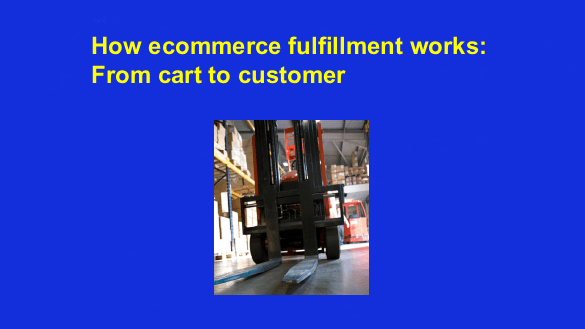
 Ecommerce fulfillment is the complete process that takes place after a customer clicks “buy” in an online store and ends when the product arrives at their door.
While it may seem like a simple transaction from the customer’s perspective, behind the scenes it involves a carefully coordinated system of technology, warehousing, logistics, and communication.
This article explains each step of ecommerce fulfillment, showing how an order moves from a digital shopping cart to a physical delivery.
1. The Customer Places an Order
The fulfillment journey begins when a customer adds items to an online shopping cart and completes checkout. At this moment, several things happen instantly:
- The ecommerce platform confirms payment.
- The order details are recorded in the store’s system.
- Inventory levels are updated.
- A fulfillment request is sent to the warehouse or fulfillment center.
Modern ecommerce systems are often integrated with inventory management software, meaning that stock levels are adjusted in real time to prevent overselling.
2. Order Processing and Verification
Once the order is received, it goes through a processing stage. This involves verifying key details such as:
- Payment authorization
- Shipping address accuracy
- Product availability
- Fraud detection checks (in some cases)
If everything checks out, the order is approved and moved into the warehouse fulfillment queue. If there is an issue—such as a payment failure or out-of-stock item—the order may be paused or cancelled.
At this stage, automation plays a big role. Many ecommerce businesses use order management systems that automatically route orders to the correct warehouse based on location, stock availability, and shipping speed.
3. Warehousing and Inventory Storage
Warehouses (or fulfillment centers) are the physical backbone of ecommerce operations. They store products until they are ordered by customers.
Inside a warehouse, inventory is organized in a structured way:
- High-demand items are placed in easily accessible locations
- Products are grouped by category, size, or shipping requirements
- Barcode or RFID systems track every item
Many businesses rely on an e-commerce fulfillment partner to manage storage, picking, packing, and shipping operations efficiently, especially when they do not have the infrastructure to run their own warehouses.
Large ecommerce companies often use multiple warehouses in different regions to reduce delivery times and shipping costs. When an order is placed, the system chooses the warehouse closest to the customer that has the item in stock.
4. Picking the Order
Once the warehouse receives the order, the “picking” process begins. This is where warehouse staff or robots locate the items listed in the order.
There are different picking methods:
- Single order picking: One picker collects all items for one order at a time.
- Batch picking: One worker collects items for multiple orders simultaneously.
- Zone picking: Different workers are responsible for specific sections of the warehouse.
Pickers use handheld scanners or mobile devices that guide them through the warehouse, ensuring accuracy and efficiency. Each item is scanned to confirm the correct product is selected
5. Packing the Products
After picking, the items are sent to the packing station. This stage is critical for protecting the product and ensuring customer satisfaction.
Packing involves:
- Checking items for damage or errors
- Selecting the right box or packaging material
- Adding protective materials like bubble wrap or padding
- Including invoices, return labels, or promotional inserts
- Sealing and labeling the package
Efficient packing is important not only for safety but also for cost control. Oversized packaging increases shipping costs, while insufficient protection can lead to damaged goods and returns.
Many fulfillment centers use automated packing systems that calculate the optimal box size for each order.
6. Shipping and Carrier Handover
Once packed, the order is ready for shipping. The package is labeled with:
- Customer address
- Tracking number
- Shipping carrier details
- Barcode for scanning during transit
The parcel is then handed over to a logistics carrier such as a postal service or private courier company.
At this point, the order officially leaves the fulfillment center and enters the transportation network. Depending on the shipping method chosen by the customer, delivery speed can range from same-day delivery to international shipping that takes several weeks.
7. Transportation and Distribution Networks
Shipping carriers handle the movement of parcels through a network of sorting hubs, transportation vehicles, and delivery stations.
A typical journey includes:
- Collection from warehouse
- Regional sorting facility
- National or international transit hub
- Local delivery depot
Advanced tracking systems monitor the package at each stage, updating the customer with real-time delivery information. This visibility has become a standard expectation in modern ecommerce.
8. Last-Mile Delivery
The final stage of ecommerce fulfillment is known as “last-mile delivery.” This refers to the journey from the local distribution center to the customer’s doorstep.
Last-mile delivery is often the most expensive and complex part of the process because it involves:
- Traffic conditions
- Delivery route optimization
- High delivery density in urban areas
- Customer availability at the delivery address
Delivery drivers scan the package before loading it into their vehicle and again at delivery. In some cases, customers may receive real-time tracking links or delivery time windows.
If the customer is not available, the package may be left in a secure location, delivered to a neighbor, or taken to a pickup point.
9. Delivery Confirmation and Customer Feedback
Once the package is delivered, the system updates the order status to “completed.” Customers may receive:
- A delivery confirmation email or SMS
- Proof of delivery (photo or signature)
- Requests for product reviews or feedback
This stage is important for ecommerce businesses because customer feedback helps improve service quality and product offerings.
Returns processing may also begin here if the customer is not satisfied with the product.
10. Returns and Reverse Logistics
Not every order ends with satisfaction. Returns are a normal part of ecommerce and require a process known as reverse logistics.
When a customer returns a product:
- A return request is initiated
- The item is shipped back to the warehouse or return center
- The product is inspected for damage or usability
- It is restocked, refurbished, or disposed of depending on condition
Efficient returns management is essential for customer trust and long-term business success.
11. Technology Behind Fulfillment
Modern ecommerce fulfillment relies heavily on technology. Key systems include:
- Warehouse Management Systems (WMS): Track inventory and guide warehouse operations
- Order Management Systems (OMS): Process and route customer orders
- Transportation Management Systems (TMS): Optimize shipping and logistics routes
- Automation and robotics: Speed up picking, packing, and sorting
Artificial intelligence and data analytics are also increasingly used to forecast demand, optimize inventory placement, and reduce shipping times.
12. Why Fulfillment Matters
Ecommerce fulfillment is more than just delivery—it directly impacts customer experience, brand reputation, and profitability. Fast, accurate, and reliable fulfillment leads to:
- Higher customer satisfaction
- Repeat purchases
- Lower return rates
- Stronger brand loyalty
On the other hand, delays, errors, or damaged goods can quickly harm a business’s reputation.
Ecommerce fulfillment is a complex but highly organized system that transforms a simple online order into a delivered product. From inventory storage and order processing to picking, packing, shipping, and last-mile delivery, every step plays a crucial role in ensuring the customer receives their purchase quickly and accurately.
As technology continues to advance, fulfillment systems are becoming faster, smarter, and more efficient—helping online businesses meet rising customer expectations in an increasingly competitive digital marketplace.