 Why your content sounds like AI-written
You know that moment when you read something and instantly feel it wasn’t written by a real person? The sentences are fine, the spelling is flawless, but there’s no warmth. It sounds as if someone stitched together the right words — without ever meaning them.
That’s what happens when writing loses its human touch. Sometimes, this happens because we rely too much on structure, templates, or AI-generated drafts. The result is clean but empty. The rhythm is flat, and there’s no sense of a real voice behind the words. You can spot robotic writing by looking for clues: too many long sentences, repeated patterns, or phrases that feel copied and pasted. It reads like text that forgot emotion.
Writers and creators now have new ways to bring natural flow back into their words. Tools that help humanize AI-generated text allow you to polish your writing and make it feel authentic again. They don’t just edit your grammar — they restore tone, rhythm, and emotion.
How to write with a human voice
Every strong piece of writing has one thing in common: it sounds like it came from a person, not a machine.
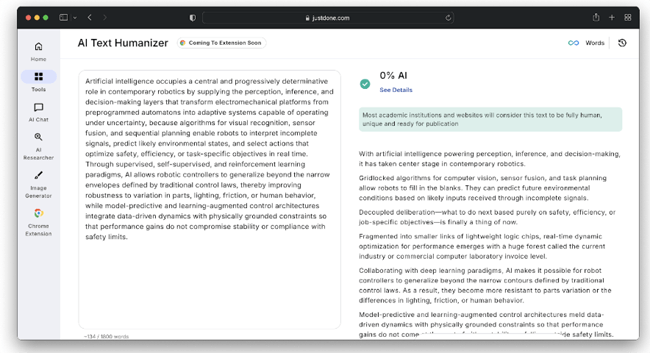
The “human voice” in writing is not about adding slang or trying to sound funny. It’s about rhythm, empathy, and personality. Take a look at JustDone AI humanizer’s example that made AI-written text sound natural:
Try reading a few sentences aloud. A human voice moves naturally — it speeds up, slows down, and sometimes pauses to make a point. You can mirror that on the page by mixing short and long sentences, adding a few questions, or using contractions like you’re and it’s.
Modern writing tools often help you find this tone. They highlight stiffness, overused words, and overly formal phrasing. You can think of them as friendly co-editors — they don’t replace your style; they help you express it more clearly.
Beyond grammar: the shift from correct to connected
Perfect grammar doesn’t guarantee connection. You can follow every rule and still sound cold.
A sentence like “The project has been successfully completed” is correct — but it says nothing about how that success feels. Try “We finally wrapped it up — and it feels great.” The grammar is looser, but the message is alive.
Writing for connection means letting go of perfection sometimes. It’s about rhythm, tone, and emotion — the things grammar checkers can’t fully measure.
One useful trick is to read your text as if you were your own audience. Would it make you care? Would you keep reading? If not, it might be time to reshape it.
Some AI assistants now give feedback on how natural and readable your writing sounds, not just whether it follows the rules. These tools make editing more intuitive — helping you focus on the reader, not the rules.
Practical tricks to convert AI text to human
Here’s how to make your writing sound more alive — small, easy steps that change everything.
Use short paragraphs. Walls of text make readers tired. Two or three sentences per paragraph are usually enough.
Break rhythm. Alternate between short and long sentences. The variation adds flow and keeps the reader’s attention.
Add mini-pauses. Dashes, commas, and even short sentences can create space — just like natural speech.
Show instead of telling. Instead of writing, “This tool is easy to use,” show it in action: “You can fix awkward phrasing in seconds with one click.”
Use real examples. Even one personal detail makes a text believable. Share an experience, a mistake, or a simple observation. It shows there’s a real person behind the words.
Revise AI draft: Checklist
No one writes perfectly on the first try. The first draft’s job is to exist — the editing gives it soul.
Start your revision by cutting what doesn’t matter. Keep only what supports your message. Every unnecessary word hides your real voice.
Then, check for flow. Read your text aloud. If you stumble or get bored, your reader will too. Adjust pacing, vary sentence length, and use active voice to add movement.
After that, look for opportunities to sound more human. Add a brief thought, a small story, or even a question. These simple touches turn generic sentences into real communication.
Finally, do a “humanizing check.” That means one last read—or using a trusted tool—to make sure your text feels natural and easy to read. It’s not about hiding that AI helped you; it’s about keeping your message authentic.
Making digital text feel human isn’t a trick or a trend. It’s a reminder that technology should help us communicate better, not faster. The best writing still comes from empathy, clarity, and rhythm—qualities machines can imitate but not replace.